
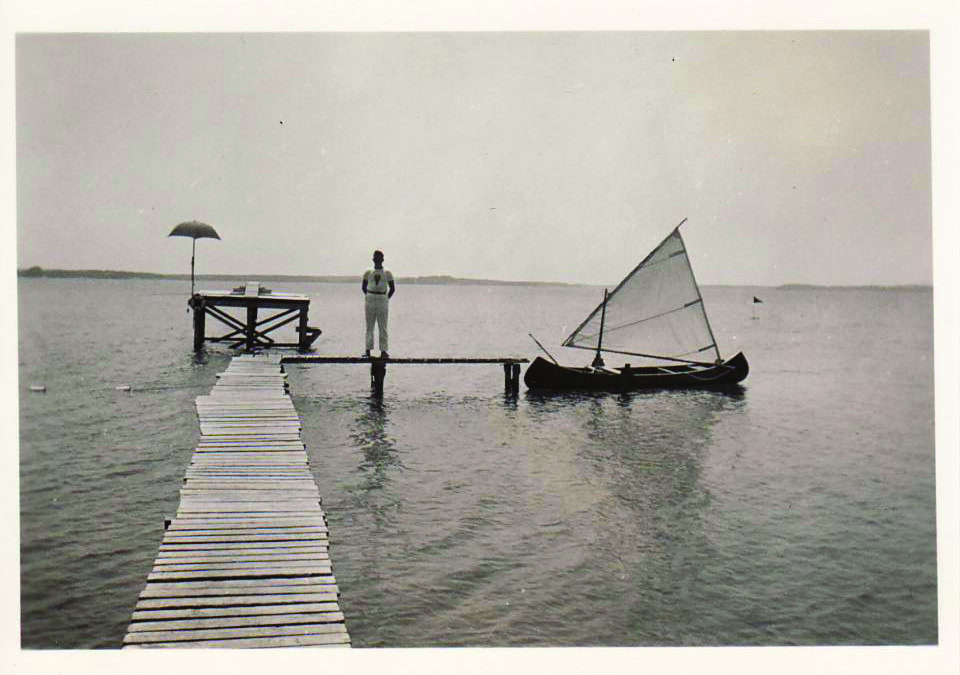
Lower Whitefish Lake has always been a place of discovery, long before paved roads and modern conveniences. In 1929, seven year old Joe Hamel first came to his family’s north shore property, hearing stories passed down by his grandparents about what those early journeys north were like. At the time, the last paved road ended in Anoka, and travel the rest of the way to Pine River was an adventure in itself. Joe remembered hearing how early visitors to the lake often relied on rented motorboats to explore the shoreline and imagine what might one day be built there.
One of those stories centered on Father Monaghan, a priest and one of the earliest pioneers on Lower Whitefish Lake. According to family recollections, Father Monaghan arrived by boat and selected the first 100 feet of shoreline, becoming the first person to build along the lake. In the years that followed, Joe Hamel’s family established their cabins nearby, beginning with 100 feet of shoreline and later adding a second adjacent parcel. These early homes became the first two cabins on the lake, marking the beginning of a growing lakeside community.
By 1924, just down the “road”, Father John P. Foley arrived on Whitefish Lake, drawn by the same natural beauty that had captivated Father Monaghan and families like the Hamels. He built a cabin close by, and Camp Foley eventually expanded east from that original site. Over time, other neighbors, including Colonel McDonald, Dr. Horton, Dr. Norman, and Mrs. Kline, built cabins to the west, forming the foundation of the close knit community that continues to define Lower Whitefish Lake today.
Father Foley had grown up in the woods of Prince Edward Island, Canada, and the Whitefish Lake region reminded him of the landscapes he loved as a child. He began bringing boys to his cabin on vacation trips, sharing the joys of nature and the outdoors. Inspired by their excitement, he decided to establish a camp so that more boys could experience the thrills that had once been a privilege for the few.
In 1925, he constructed a T-shaped building alongside his main cabin for a bunkhouse and dining hall, using armory cots filled with straw for beds. That first summer, sixteen boys enjoyed week-long stays on Whitefish Lake. By 1927, Camp St. Thomas, later Father Foley’s Camp for Boys, had expanded to include multiple cabins, docks, boats, and even a wooden diving tower.
Faith and vision were central to Father Foley’s mission. Early on, he promised the Blessed Virgin that if camp succeeded, he would dedicate a chapel. That promise became reality in 1934 with the construction of Our Lady of the Snows, built using local fieldstone and cypress benches soaked in the lake. The first Mass was celebrated on August 5, 1937, the feast day of Our Lady of the Snows, transforming a dream into a lasting symbol of dedication and devotion.
Father Foley led the camp for 25 years before passing the reins to former camper and staff member Robert E. Schmid in 1949, while continuing as chaplain until 1963. His vision, humor, and humility left a lasting mark. More than 4,000 boys experienced the lessons of community, skill, and character development that continue to shape Camp Foley today.
Stories like those of the Hamels, Father Monaghan, and Father Foley remind us that Lower Whitefish Lake is more than land. It is shared history, community, and a place where generations have discovered belonging. Since 1919, a strong sense of connection has bound neighbors, families, and Camp Foley together through stewardship of the lake and love for this special place.
Camp Foley’s story continues because of the people who care deeply about this place. If you feel inspired, we invite you to support the next generation of campers and help preserve the legacy we all share.
From the first cabins in 1919 to Camp Foley’s 100-year history today, the spirit of community, discovery, and connection remains as strong as ever.
We invite you to watch Joe Hamel’s full interview, which offers a meaningful glimpse into the early days of Lower Whitefish Lake and the families who helped shape this community.